Showing posts with label book review. Show all posts

Monday, March 2, 2020

Nothing to See Here

Nothing to See Here by Kevin Wilson
Book Review


As the grandmother of twins, I wanted to read this book as soon as I heard of it. I expected the book to be kind of a joke as I tried to imagine spontaneously combusting twins, but Nothing to See Here is a poignant story of children who have not been well cared for, including the narrator.

Lillian tells the story with her cool, painfully honest but don't-give-a-damn voice. She's 28, smoking a lot of weed, and living in the attic of her emotionally detached mother's house when her college friend Madison asks her to come live with her and her senator husband and his twins who will be moving in after their mother's (the senator's ex-wife) death. Lillian will be paid well to take care of them, and oh, there's one little important detail to be dealt with that Lillian isn't told until she gets there: they spontaneously combust when they're upset.

Lillian doesn't see many options for a better life and she's curious, so she agrees to come to their mansion in Franklin, Tennessee. She and Madison are friends but not in a confiding, companionable way. They keep in touch by letter (it's 1995) and Lillian knows nothing about Madison's interior life. At one time Lillian was ambitious and smart and pursuing a good college education without a drop of help from her single parent mother, but her relationship with Madison led to the destruction of that dream. Lillian wonders if there will be a reckoning between them, but soon realizes there won't be.

Instead she decides to take advantage of living like a rich person--Madison's life instead of the life Lillian had wanted for herself. But it's awkward, starting with cucumber sandwiches that look like dollhouse food.

We were, I understood, being polite. "But now you're here!" she [Madison] said. She poured sweet tea, and I drank it down in, like, two gulps. She didn't even look surprised, just filled my glass up again. I ate one of the sandwiches, and it was gross, but I was hungry. I ate two more. I didn't even realize that there were tiny plates stacked on the tray. I'd held the sandwiches in my dumb hands. I didn't even want to look down at my lap because I knew there were crumbs there.

When the twins move in, Lillian has to immediately invent a way to keep them from burning down the special house away from the mansion that's been built for them, which she does almost instinctively. She also invents a curriculum to occupy the days.  Lillian has no idea what she's doing but hour by hour, day by day, she recognizes they share her feeling of belonging to no one and a kind of existential despair. They don't trust her at first and she doesn't blame them. She earns their trust by letting them see the truth about her loser self. And they share a growing mutual distrust of Madison; their father, Senator Jasper Roberts; the employee Carl who tries vainly to manage the three of them, and even Madison and Senator Roberts' three year old son (the twin's half-brother), Timothy.

It was a little harder to believe Lillian found her way with the twins so surely than it was to go along with the spontaneous combustion condition, yet I did love this book. The ending came together in a satisfying way. Kevin Wilson is a smart, funny writer. An extra little kick of delight for me was discovering he is a nephew of my husband's high school classmate, whom I'd just met this past summer. At that time I heard the story about how the horses were hidden during the Civil War from the Union Army by leading them up the stairs of his mansion. When that same thing showed up in this book I thought maybe all the mansion owners took their horses up the spiral staircase to be hidden from the Yankees.


Wednesday, October 23, 2019

Handywoman

Handywoman by Kate Davies
Book Review


I like to knit, mostly sweaters. It's fun to find knitwear designers who have a look or style that pull me in over and over as I discover and research their creations. When that happens, I not only track down whatever I can find on the internet that they've made, I like to discover more about their lives. Where do they live? How'd they get into knitting and designing?

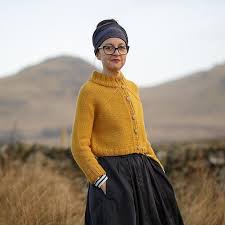
Kate Davies is a knitting designer I recently discovered and admire. I would make just about any of her sweaters. I was further enchanted when I learned she lives in Scotland near the gorgeous West Highland Way, a 95 mile hiking trail my husband and I backpacked in 2012, and that it inspires many of her designs.

I also learned she became a professional knitwear designer after having a debilitating stroke several years ago while she was in her thirties. She's written a memoir, Handywoman, an account of who she was before the brain injury, how she dealt with it, and how her life was changed afterwards. It's also an intelligent, thoughtful, methodical exploration of all facets of being in the physical world, and in communities. Davies was a maker and knitter before her brain injury, but an academic by profession. She turned her intellect to understanding precisely how her changed self interacted with the environment. Along the way she determined she would start a new profession: knitwear designer.

The tone of the book is serious and thorough. For example, Davies' chapter "Raised" takes us through her experience and epiphany being assisted with the Etac turner, a non-motorized piece of equipment for transferring someone that leverages the weight of each person. She does so in explicit detail: its construction; each choreographed movement as the technician secures a brake, stabilizes the turner; each of Davies' own movements in response; and her elation at the realization her own body participates in the entire process, never surrendering to the complete trust of another person's physical effort.

She dissects why that is, and begins to look at designed objects with new eyes. She says, "I now think of the habit of attentiveness I began to develop during the time I spent on the neurology ward as a form of material engagement. Material engagement is both reflective and participatory. . . After my stroke, I came to understand that, in the processes of their making and their potential for creative accomplishment, tools and objects possessed a wisdom that was far greater than my individual mind and body."

But Handywoman is not all about the physical and social experience of brain injury. There are plenty of fascinating stories about her interactions with textile making communities. My favorite was her journey to the Shetland Islands and developing a deep connection and relationship with the woman and culture of knitting there.

I'll probably read this one again because her thoughtfulness about the dailyness of life is inspiring. Meanwhile, I've decided which of Kate Davies' designs is on my project list: the Carbeth Cardigan. Davies is well known and beloved: over 1,800 people on Ravelry have made, or want to make, this sweater, too.


Monday, September 2, 2019

The Lager Queen of Minnesota

The Lager Queen of Minnesota by J. Ryan Stradal
Book Review

Edith and Helen are sisters who grew up on a farm in north central Minnesota in the 1940s to the early sixties. They become estranged when their father leaves the farm to Helen, the younger, at his death some time in the 1960s.

Before that, Edith and her new husband, Stanley, leave their roles as caretaker and hired hand to move to the small city where's he's been offered a job. Stanley's no farmer and Edith's dad is not well, but this decision surprises Helen because Edith is loyal, hard-working, and lives to help people.

Helen hasn't paid attention to what's happening at the farm since she left for college three years ago, much less to Edith, but she sees how to turn this event to her advantage. Helen fell obsessively in love with the taste of beer and the process of brewing it when she was 15, and has been spending her college years learning everything she can about it. Her fiance, Orval, is from a beer-making family whose brewery has failed. Helen and Orval are trying to revive the business, but they need money.

Helen persuades her father, who is clearly not going to last much longer, to leave the farm to her. She promises she will give Edith her share when the brewery is making money. She and Edith never speak after Helen breaks the news, and the sharing plan falls aside.

Edith is not the kind of person to dwell on financial misfortune; she's much more sad to have no parents and an estranged sister. Edith and Stanley never have much money, and neither does anyone else they know. Edith resolutely, sometimes even cheerfully, shrugs off never owning a home, having no savings, and working well past the age she is when the book starts. (She's 63 and working in the kitchen of a nursing home.) Helen is ambitious, driven, and lonely (though she has Orval) but she doesn't care. Success is what she wants at all costs.

Edith's granddaughter Diana becomes the third major character in the story. A mixture of Edith's Minnesotan unpretentiousness and morality, and Helen's shrewd assessment of how to profit from all she encounters, she's the catalyst for Edith and Helen to find the end of their stories.

We know the setting of a book often works as a character in its own right. In The Lager Queen, it's not quite so much the rural landscape of north central Minnesota as it is the sturdy, unassuming civility of Edith and her friends. They judge people who don't play by their rules: don't swear, don't ask personal questions, be friendly and honest--but they keep it to themselves. Emotions are sublimated. But once in a while they'll make a subtle, insider joke about someone with people they trust.

My dad grew up just like that in the same area, and I recognize my cousins' way of talking in this book. Stradal, who's from Minnesota, has captured the personality of the region in a laugh-out-loud, entertaining, yet respectful, way. He also must love beer. I don't drink it, but this book is saturated with detailed descriptions of hops, brewing facilities, types of beer and their taste. I started to want a cold bottle.